
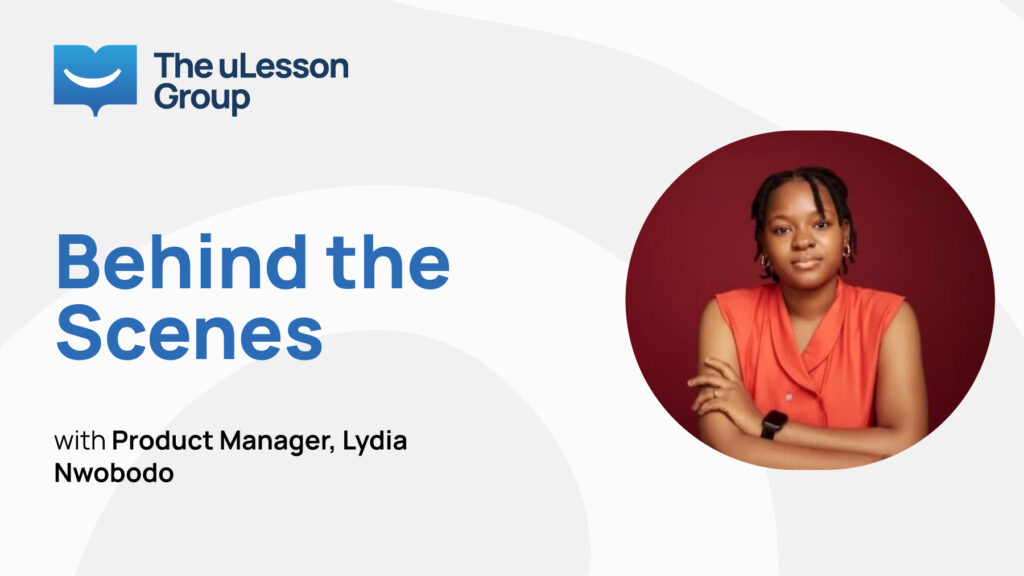

For those who’ve ever taken a proctored exam at Miva Open University without a hitch since August 2025, you probably have Lydia Nwobodo and her team to thank. The Product team has been quietly orchestrating the systems that make exams run smoothly—from proctoring tools to student feedback loops—as well as other software applications, while keeping their cool in what Lydia describes as a fire-filled room that’s somehow fine.
They juggle feature requests, troubleshoot bugs, and refine user experiences with an impressive mix of calm and precision. Lydia Nwobodo, who joined Miva Open University (a subsidiary of the uLesson Group) in May 2025, brings her love for education technology and her people-first approach to leadership, setting the tone for a team that values collaboration as much as innovation.
Let’s step behind the curtain with Lydia and find out what it’s really like to be part of the uLesson Group’s Product team.
Product Manager on the Exam Portal Team
Can you briefly tell me about yourself and what you do at the uLesson Group?
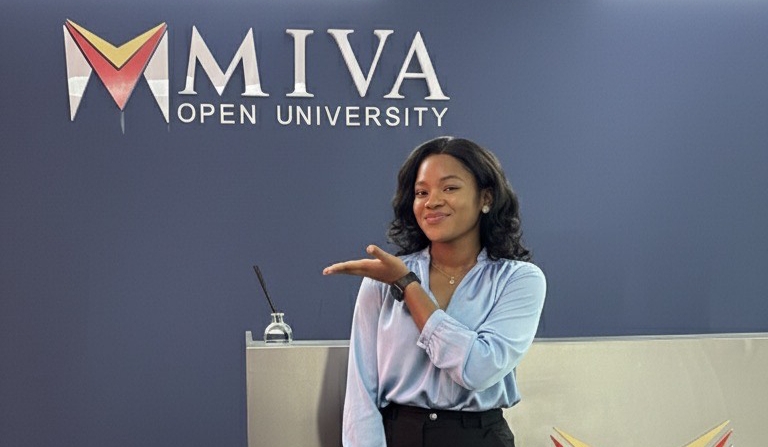
Hi. My name is Lydia Nwobodo, and I’m a product manager on the Exam Portal team (a sub-unit of the Product team) at Miva. Basically, I help shape the exam experience for students and faculty. My job is to take the ideas and feedback from students and faculty members and turn them into real, usable features that deliver value to them.
What would surprise people most about how you work and your day?
I think what would be most surprising is the sheer number of questions I have to ask people every day and the non-stop conversations. Depending on the phase of the product development cycle, we have constant conversations about what we’re building, the blockers we’re experiencing, our priorities, and our progress. It’s the sheer volume of context-switching that would surprise most people.
By context-switching, you mean?
Moving from one feature to another, from one project to another, or from one issue to another. It feels like we’re constantly running on a train track. There are constant trains moving. You need to know which particular project, feature, or task someone is referring to when they bring up something randomly, and you just need to remember all the context around it.
What part of your job do your close friends not understand?
People don’t really understand that my work is heavy on people management. When you tell people you’re a product manager in the tech space, they always think you’re actually doing the coding or the design work.
They don’t realise that at the core of product management is people management. The bulk of what I do is conversations, negotiations, and planning. The summary is that I’m managing the people who get the work done.
Team Dynamics and Achievements
Can you bring us to the bigger picture? What does your department actually do, and how does this connect to the uLesson Group?
My team, the Product team as a whole, provides the software applications that help manage the entire university process. This includes the student experience, communication, lectures, exams, and student information management, as well as our AI tool (MIND). We’re also expanding our support to include students who are about to graduate. It all ties back to our goal of preparing students for opportunities outside the university.
If your department disappeared for a day, what’s one chaos you think would break out?
We’d hear it from the students. For starters, nobody would be able to take any lectures. It would be real chaos. I mean, where do they start from? International students and students across the country cannot start coming down to Miva headquarters to do anything. It’d be like the university just went “poof” and doesn’t exist anymore.
Can you describe your department in three words?
I think the first word that comes to mind is intimate. We understand how critical everyone’s part is. We’re well-versed in what developers, designers, QA engineers, and DevOps are doing, so we can easily support ourselves.
Another term would be “learning point”, because being intimate with all these roles helps you learn from them. Another description would be funny or hilarious because there are a lot of inside jokes on Slack. There’s always something to laugh about every day.
That brings me to my next question: who is the funniest person on your team and why?
I think the funniest person on my team would be our QA engineer, Mercy Akinwale. I say Mercy because she’s very honest and blunt. She doesn’t have much of a filter, so she just says what she thinks, and it makes everybody laugh.
What has been your favourite team tradition so far since you joined Miva?
My favourite one would be what we just started about two months ago: the rotation of our retro ceremony. Normally, retros are hosted bi-weekly by the product managers on a rotational basis, and there are four of us (product managers) on the Product team, but we opened it up to the entire team.
We’ve had developers and a designer host the meetings, and it’s been interesting seeing people come out of their shells and get creative with how they engage the team.
You just mentioned that the product team has four product managers. What do the other three do?
We have Chidubem managing the team for the Moodle LMS and the Miva X app. We also have Grace, who is the product manager for the Student Information System (SIS) tool. Lastly, we have Osayi, who’s the product manager for the Miva Connect tool that we’re building for the alumni.
How big is your team?
We’re nine in total on the Exam Portal team: four front-end engineers, two back-end engineers, two QA specialists, one product designer, and me. I manage eight of them directly.
What’s one recent achievement your team is proud of?
We concluded the August exams in August. That was a big one for us because we had over 6,000 students taking exams across the entire week. The first time the product was used was during deferred exams in May, and we didn’t have that many students [taking exams]. On the first day alone, for the August exams, we had over 7,000 submissions.
We mentally prepared to support 10,000+ students, but some people deferred to September. Tuesday of that week was interesting because we were expecting people to have issues, but we didn’t have any until like 3 p.m.
The exam process was just smooth, and we got really good feedback. It was a major achievement for us this year.
What’s one way your team has brought innovation to how we work or serve students and learners in Miva?
One way my team has brought innovation to how we work, aside from the experience of having proctored virtual exams, is setting up ‘tracking’ for QA efforts internally.
Product development requires that you first design a page and then look at what backend functionality is needed on that page. Then you implement the design of that page and integrate it with the backend.
These phases require step-by-step QA. A QA engineer needs to confirm if something meets the requirements, needs to be changed, or was overlooked. We normally used to do that QA without recording that it was being done.
What that meant was that the efforts and the impact of a QA engineer were not obvious until something went into production and it broke. So, finding a way to track the acceptance criteria for every single piece of work that the QA needs to go through and confirm is one thing we’ve added.
Purpose, Passion, and More Products
What keeps you inspired to do your best work?
Just knowing that the work I’m doing today is directly impacting our students’ university experience. Sometimes I think back to the frustrations I had in school and how I thought there were ways to make things simpler. Now I’m in a position to actually do that, and it definitely keeps me inspired.
Before joining Miva, what roles were you involved in?
I’ve been a product manager since 2020. I started in the logistics space, building software for shipping goods from outside Nigeria into the country and for last-mile delivery. Most of my experience has been in logistics and e-commerce, specifically developing products in these areas.
By 2023, I transitioned briefly into the health tech space, working on an AI-driven project for health monitoring and tracking.
Interestingly, I’ve always been passionate about edtech. I’d been reading about the industry for years and had even interviewed with a few edtech companies in the past, though nothing was finalised. When I saw the opportunity at Miva and spoke with the previous product manager, I got genuinely excited about what they were doing, and that’s how I joined.
Is there a moment that made you think, “This is why I love my job”? Both as a product manager in general and as a product manager at Miva?
Yes, I get those moments frequently. They usually come when a new feature request comes up. I enjoy digging deep to understand what problem the feature is supposed to solve and why that problem exists.
For instance, someone once requested a search function for questions in the admin portal. At first, it seemed simple, but when I asked why they needed it, we discovered the real issue: our CSV files weren’t being checked properly before import. That was causing disorganisation, not the lack of a search button.
So instead of adding another button (a temporary fix), we focused on solving the root problem: improving the CSV process. Moments like that remind me why I love this job.
People often think product managers should have all the answers, but in reality, we need to have all the right questions. Asking “why” helps uncover real problems and ensures we’re building solutions that add true value.
Otherwise, you end up with cluttered products, full of buttons but lacking purpose.
What’s the best piece of feedback you’ve received here at Miva, and what did it change for you?
I’ve actually only received one formal round of feedback so far since we’ve only had one exam since my joining Miva, but thinking through them, one that stood out came during the mock exams ahead of the August exams.
Students had raised concerns about the sensitivity of our proctoring tool. They weren’t doing anything wrong, but things like someone walking past them were being flagged as violations. Clearly, that wasn’t fair. So, based on their feedback, we reduced the sensitivity and even disabled mid-exam alerts so they wouldn’t be distracted.
That decision really made a difference; if we hadn’t implemented it before the August exams, we’d have had a lot of unhappy students. The idea was to maintain exam integrity, not disrupt the experience. We still had the proctoring records for post-exam review, but it was important to keep the exam flow smooth.
That’s really proactive.
Laughter and “Fire” Moments
What part of your daily work do you most look forward to?
I look forward to morning stand-up calls. It feels like a “return to base” moment. Everyone shares what they’ve worked on, what’s been done, and any blockers they’ve encountered. It helps me see how the team is progressing and where someone might need support.
Sometimes we realise during those check-ins that a task affects more areas of the product than we initially thought. So, it’s a great space for realignment, deciding whether something should go in version one or version two, for example.
If your job were a meme, what would it be and why?
Definitely the “This is fine” dog sitting in a burning room! That’s what being a product manager often feels like. There’s always a new deadline, shifting priorities, or an urgent requirement, but you just have to stay calm in the middle of the chaos.

Do you have any quirky home-office habits you’ve picked up working remotely?
I actually do my stand-ups standing up, literally! Now it’s a routine: I stand during stand-ups and some meetings, and it keeps my energy up. I think standing up helps you think faster. I also started standing up regularly during the day from my desk because they say sitting too long isn’t good for you.
If your team were a TV show, what would it be called?
One Day, One Problem. Every day brings a new challenge to solve. My team even jokes about it.
What Gen Z slang do you know?
I don’t really identify as Gen Z, but I think Gen Z slang is very expressive. I like calling things “fire” when things are very good.
Being a Part of the Mission
When you think about the impact of uLesson and Miva across Africa, how does that make you feel?
Honestly, proud. Seeing how much we’ve achieved in such a short time is incredible. Being part of something that’s creating real opportunities for people feels meaningful.
What does it mean to be building something so ambitious from within?
It means that I get to play my part in shaping students’ university experience. I remember so many situations in school that I experienced that were just not fun. It’s an opportunity to keep my users, the students, in mind in what we’re building so that they know the university exists not just to educate them but to make their journey easier.
What would you like students to know about the work happening behind the scenes?
I want students to know that they can shape a lot of what is being done behind the scenes. Their feedback truly matters. The features and tools we build are shaped by their experiences. So, I encourage them to give detailed, honest feedback, whether through surveys or casual chats, because we’re listening, and it directly improves what we create for them.
What’s one word you’d use to describe the uLesson Group?
Efficient. The way teams are managed, constant feedback that is acted on, and how people are encouraged to grow. It’s a continuous cycle of improvement. It pushes me and all of us to be better every day. And I love that it happens in a way that there is still mutual respect.
Is there anything you’d like to say to the Miva team or about Miva?
[To the Miva team], just encouragement to keep up the great work and maintain the positive energy and respect that make working here such a good experience.
Conclusion
From asking the right questions to managing chaos with calm precision, the Exam Portal team and the Product Team as a whole embody the thoughtful coordination that powers Miva’s seamless university experience.
Their work goes beyond coding and troubleshooting; it’s about anticipating needs, refining processes, and ensuring every learner can focus on what truly matters: performing at their best.
Behind every smooth session on Miva’s software applications lies a collective of thinkers, builders, and problem-solvers who believe that great technology is driven by empathy and curiosity. For this team, every “one day, one problem” moment is another chance to make learning smoother, smarter, and more reliable for students across Miva Open University.